
Envision a future where the passage of time does not mean a decline into disease, a world where reaching your 80s, 90s, or even beyond is not synonymous with the burden of cancer, neurodegeneration, or heart disease. This is the ambitious goal that Calico and the Broad Institute of MIT and Harvard are pursuing through their decade-long partnership, driven by a shared curiosity and belief that this future is possible.
By mid-century, there will be more than 450 million people over the age of 80 globally, three times as many as there were in 2021.1 Behind that demographic shift lies an opportunity to redefine what “old age” looks like. Today, advanced age remains one of the strongest predictors of many chronic conditions.2 Although scientists have made significant progress in mapping individual genes and pathways, the complex biological networks of aging remain largely uncharted territory.
The collaboration between Calico and the Broad has contributed to important advances in understanding aging through a combination of scientific discovery and translational research. Together they have helped identify several targets, including the promising PTPN2/N1 phosphatase inhibitor, which addresses a target previously considered undruggable. A similar approach is now guiding their efforts in Parkinson’s disease.
Building a Productive Relationship
When Calico was first launched by Google and its founder and CEO Art Levinson in 2013, its leadership team flew across the country the following year to meet with the Broad team. There were just five Calico employees at the time, but their visit signaled the beginning of a deep and ambitious scientific partnership, one that continues to shape the future of aging and age-related disease research more than a decade later.
That early meeting reflected a core part of Calico’s strategy: seeking out collaborators who share a passion for foundational science and the drive to translate complex biology into meaningful therapeutic advances.
“Collaborations were always going to be an important component of advancing the Calico mission,” says Jonathan Lewis, Chief Business Officer at Calico. “They gave us a way to jump-start what we were doing as we built our own labs and research, and they continue to accelerate progress in areas where shared expertise leads to new discoveries.”

Together, the teams work side by side to identify promising biological mechanisms and move them from conceptual breakthroughs to viable drug candidates. With the collaboration extended in 2019 and again in 2024, it continues to serve as an example of how academic and industry partners can work together in a truly integrated way.
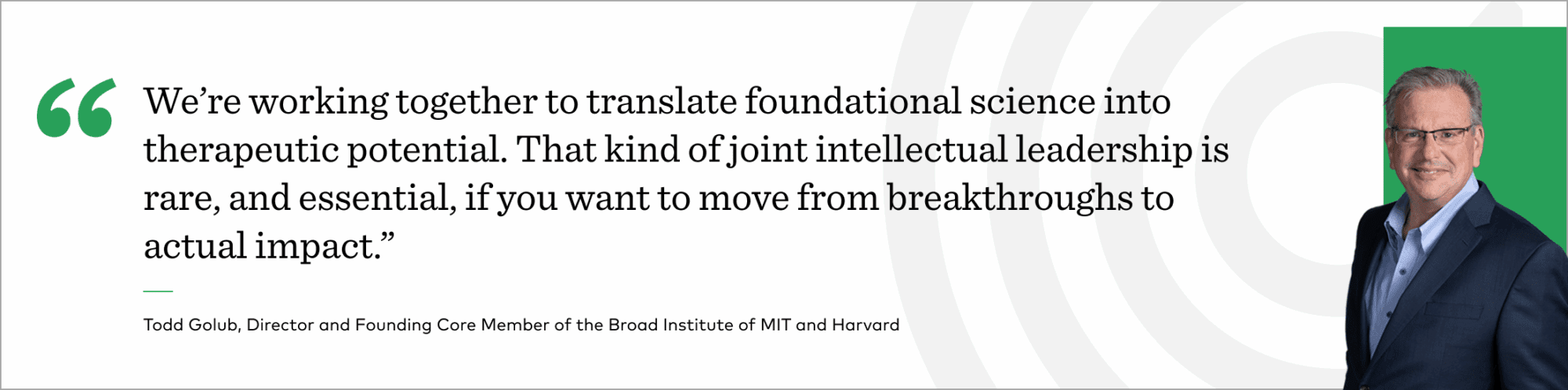
“Our partnership with Calico is not just about handing off discoveries,” says Todd Golub, Director and Founding Core Member of the Broad. “We’re working together to translate foundational science into therapeutic potential. That kind of joint intellectual leadership is rare, and essential, if you want to move from breakthroughs to actual impact.”
Pushing the Boundaries of Tumor Immunology
One area where the Calico–Broad collaboration has been productive is in immunotherapy discovery. Together, the teams have advanced large-scale in vivo screening programs that have helped create a better understanding of the genes influencing how tumors respond to immunotherapy. The effort has since expanded to include the analysis of human tumor samples, including a project to identify new immune and tumor-intrinsic targets.
“This collaboration is showing what’s possible when two teams combine their strengths and stay focused on a shared goal,” says Marcia Paddock, Director of Oncology New Target Development at Calico. “By designing and applying new tools together, we are advancing real drug candidates and generating insights into tumor biology that were previously out of reach.”
The development of Calico’s PTPN2/N1 phosphatase inhibitor highlights the translational impact of the collaboration. Initially identified by Broad scientists through the Tumor Immunotherapy Discovery Engine (TIDE) platform, the target came from a class widely considered undruggable. Building on the Broad’s foundational discovery, Calico’s team applied its deep immunology and drug development expertise to validate the target and explore its therapeutic potential in collaboration with AbbVie. They developed models to show how inhibiting PTPN2/N1 could trigger a cancer-fighting immune response beyond what current checkpoint inhibitors achieve. Now known as ABBV-CLS-484 (osunprotafib), the program has progressed into a Calico-led clinical trial.
“It was an improbable drug discovery project that ultimately became the flagship example of what this approach could achieve,” says Robert Manguso, a Principal Investigator in the Massachusetts General Hospital Center for Cancer Research, an Associate Member at the Broad and Co-Director of the TIDE program. “I think one day there will be people who get better because of this journey we’ve been on together.”

Evolving Toward New Frontiers
Building on the progress of this relationship, the Calico-Broad collaboration continues to evolve. While most of the joint work so far has taken place in oncology, the partnership recently set its sights on neurodegeneration. Collaborative work to identify and develop targets related to Parkinson’s disease is already underway.
“Addressing the challenge of aging requires a breadth of expertise and perspective that no one organization can fully provide on its own,” says Arthur Levinson, founder and CEO of Calico. “From the start, we have embraced collaboration as a core part of how we work. Productive partnerships, whether with leading research institutions, emerging biotech companies, or other mission-driven organizations, expand what is possible and help us create a clear path from scientific discovery to potential therapies.”
1World Health Organization. Ageing and Health Fact Sheet. Accessed August 2025. https://www.who.int/news-room/fact-sheets/detail/ageing-and-health
2The Centers for Disease Control and Prevention. Older Adults Fact Sheet. Accessed August 2025. https://www.cdc.gov/cdi/indicator-definitions/older-adults.html