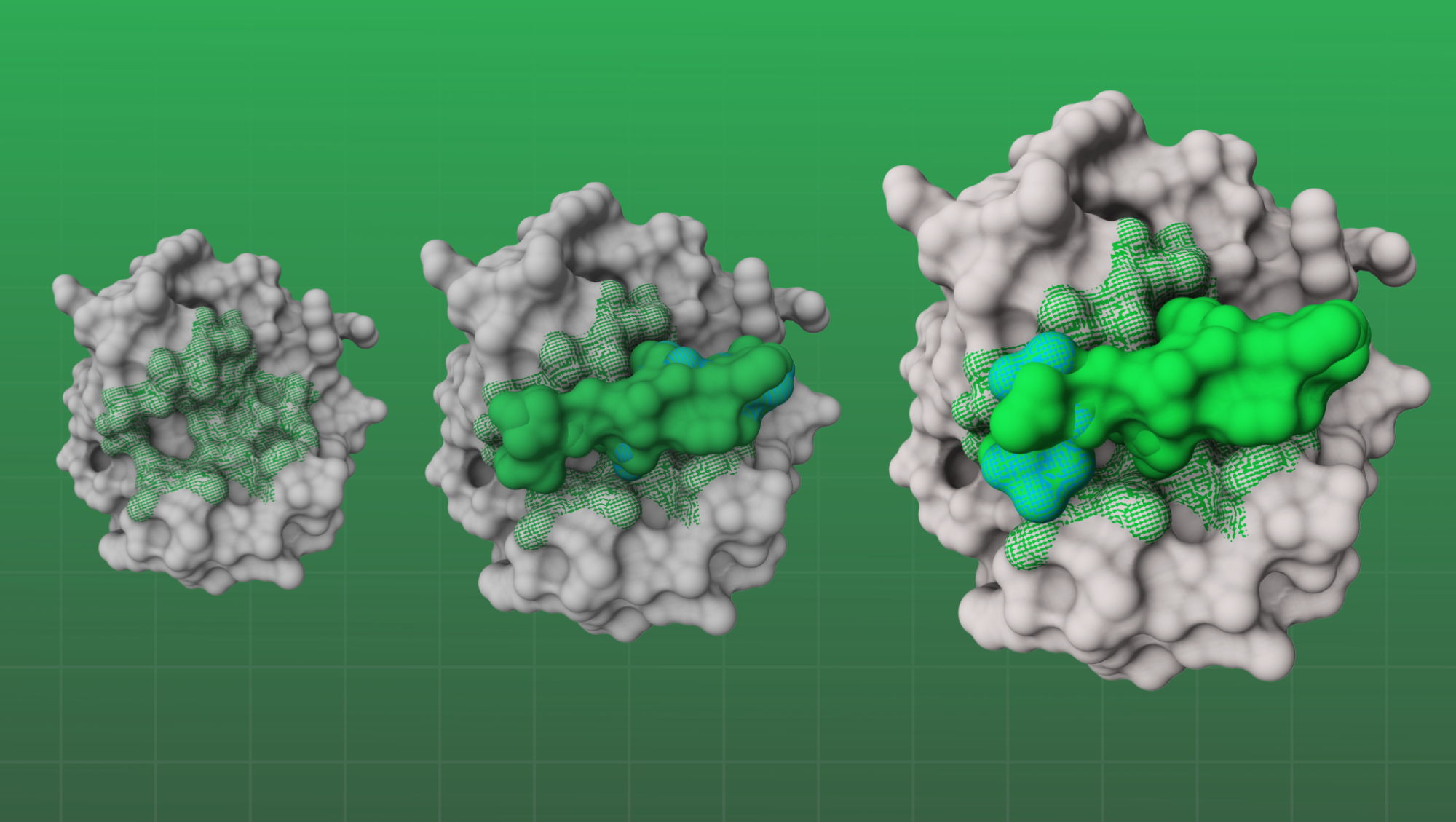
Calico has introduced CAMOLE, an integrated platform to design and optimize therapeutic peptides by bringing together generative all-atom diffusion models with drug development expertise
Therapeutic peptides offer unique opportunities for difficult targets, allowing scientists to design more precise molecules that bind to broader protein surfaces. However, turning promising peptide designs into viable therapies requires optimizing drug-like properties including potency, selectivity, bioavailability, pharmacokinetics and other critical attributes for how they perform in the human body.
To bridge this gap, Calico developed a novel design-test-synthesize platform called CAMOLE (Calico All-Atom Molecule Engine). Built through close collaboration between Calico machine learning engineers and laboratory scientists, the platform integrates in silico peptide design directly with physics-based modeling, chemical synthesis, and experimental testing. This creates an iterative workflow in which computational predictions and physical experiments inform and refine each other with each round of design and testing, accelerating the development of potential peptide-based therapeutics.
“Machine learning is expanding our ability to pursue difficult targets involved in the complex biology of disease,” said Phil Kym, Calico’s Head of Drug Discovery and Development Sciences. “CAMOLE brings our machine learning and drug development scientists together so that what we learn in the lab shapes what we design next. That exchange is essential to turning promising ideas into potential medicines, and it gives us a way to explore more of what peptides can offer.”
Atomic-Resolution Modeling for Non-Standard Chemistry
At the center of the CAMOLE platform is an all-atom diffusion model. This generative system predicts the full 3D structure of both the peptide and its target protein using a fully atomistic approach that represents individual atoms and their bonds throughout the process. By preserving this detail rather than simplifying amino acids into larger building blocks, the system allows researchers to perform highly precise design and evaluation using non-canonical amino acids.
While early computational tools were trained to design peptides with standard, canonical amino acids found in natural proteins, real-world peptide therapeutic optimization requires non-canonical building blocks, such as mirror-image amino acids and specialized chemical modifications to optimize their drug-like properties. The CAMOLE platform allows researchers to design de novo peptides with these non-standard building blocks and accurately predict the structural impact of their inclusion.
“Peptides have a lot to offer, and we’re still learning how much we can do with them,” said Phil. “CAMOLE combines the predictive power of machine learning with the judgment of experienced drug developers, helping us make better decisions earlier about which peptides have a path to becoming medicines. It’s an exciting application of AI with real potential to improve human health.”
A High-Bar: Selective Inhibitor Design for MMP12
To evaluate the platform’s performance against a notoriously challenging family of biological targets, the Calico team focused on matrix metalloproteinases (MMPs). These protein-degrading enzymes feature active sites that are nearly identical across different protein family members, making it difficult to block one specific enzyme without disturbing others.
The team targeted MMP12, an enzyme implicated in chronic inflammatory lung conditions like emphysema and asthma, which become increasingly prevalent with age. The goal was to design a molecule engineered to selectively inhibit MMP12 while leaving closely related proteins untouched to avoid unwanted side effects.
“The most interesting moments are often when a molecule doesn’t behave the way we expected,” said Matthew Bratkowski, Associate Director, Structural Biology. “As a scientist, you want to understand why and use that insight to decide what to make next. Finding the best design is not about improving one property in isolation. It is about understanding the tradeoffs and finding the right balance.”
Guided by CAMOLE’s 3D structural predictions, the team identified non-obvious peptide modifications that could lead to potent and selective MMP12 binding peptides. Through the exploration of these modifications, the team developed a selective inhibitor that was shown to be significantly more potent than initially designed peptides.
Unlocking New Opportunities in Peptide Therapeutics
The CAMOLE platform is generally applicable to other therapeutic targets to quickly drive discovery efforts, offering promise for targets that have been considered “undruggable” by traditional small molecule inhibitors. Moreover, progress in peptide formulation suggests that the CAMOLE platform may facilitate discovery of peptides that can be developed into orally bioavailable medicines, offering a delivery advantage over injectable biologics-based therapeutics.
As the team applies the CAMOLE platform to new targets, the focus remains on what these design capabilities could ultimately mean for patients. “What motivates me personally is taking advances in AI and machine learning beyond computational benchmarks and putting them to work to design better molecules and move towards medicines that may someday improve people’s lives,” said Jeffmin Lin, Staff Engineer on the Computing and Machine Learning team.
To learn more, read the preprint: “Accelerated discovery and optimization of a potent and selective MMP12 inhibitor with the machine learning platform CAMOLE-1.”