Across the genomics community, scientists are using artificial intelligence (AI) to uncover new insights from DNA and RNA data. But realizing the full potential of these models still requires a significant amount of computing power.
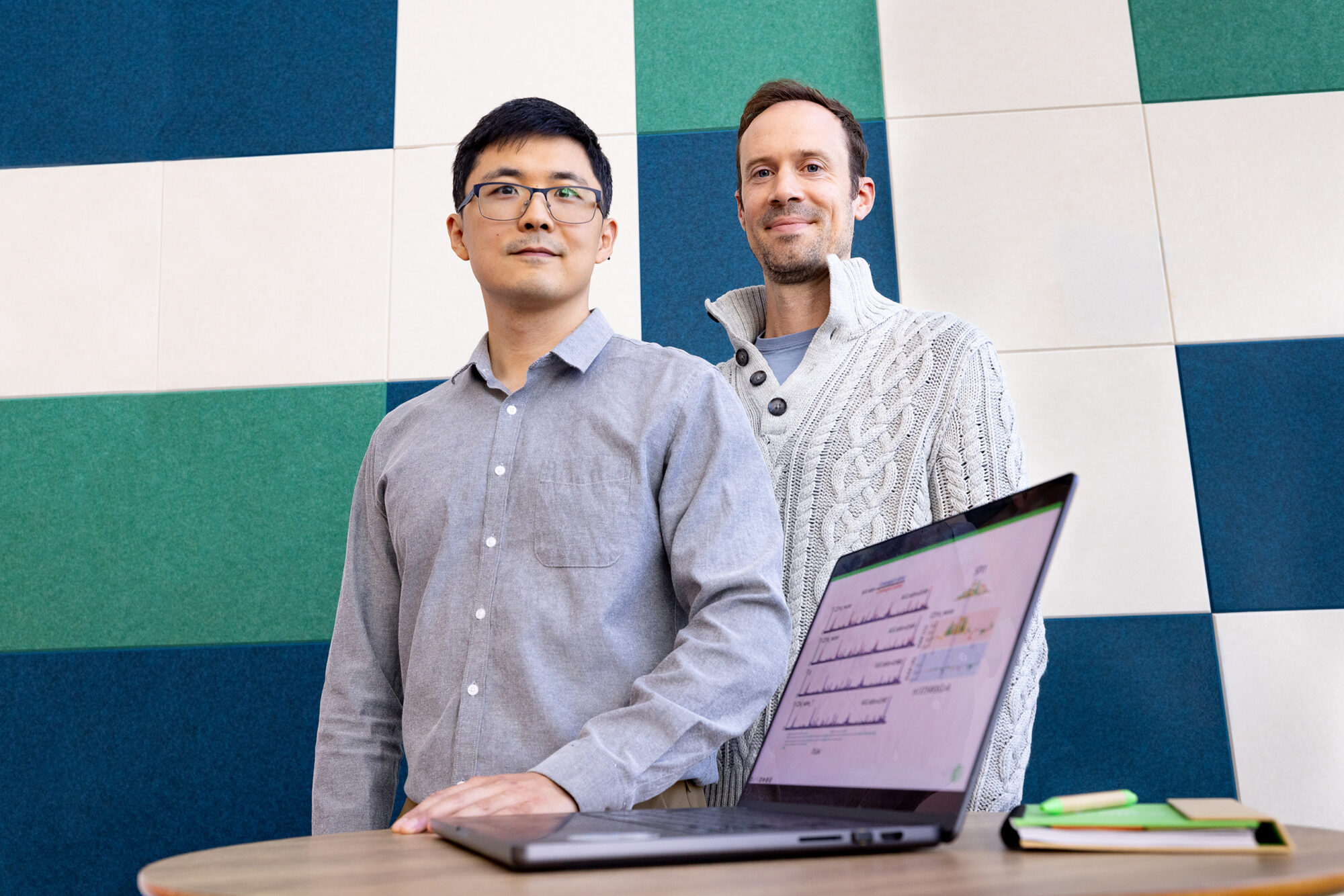
To bridge this gap, Calico scientists Han Yuan, Johannes Linder*, and Principal Investigator David Kelley developed a new framework to expand access to genomic deep learning models, allowing researchers to utilize powerful tools with significantly lower memory and runtime requirements.
In a study published in Genome Biology, David and his team developed and evaluated a transfer learning approach for Borzoi, a model Calico scientists designed to predict gene expression profiles from DNA sequence data. The goal was to simplify how the broader scientific community adapts this massive model to their own specific datasets.
“In machine learning right now, many groups use transfer learning to adapt large AI models that have already seen lots of data, even if it’s not necessarily specific to the problem they’re looking to solve,” David said. “There are many techniques in the broader machine learning field for doing this, but in genomics, there had not previously been a rigorous study of how to apply them effectively. With this study, we are able to democratize access to genomic deep learning models.”
Adapting Borzoi for New Frontier
Since the release of Borzoi in 2025, the Kelley Lab has seen a surge in requests to customize the tool for specialized applications. While the model was originally trained on thousands of cell types and tissues, it cannot capture every biological context or disease state.
“We find, in many cases, Borzoi performs well in modeling gene regulation,” said Han Yuan, the study’s co-author and Senior Engineer at Calico. “But in cases where Borzoi had never seen the cell type or disease state, it would be time-consuming to train a new model from scratch.”
To address this challenge, Han tested whether he could efficiently adapt Borzoi to new biological contexts through transfer learning, without the need to start from scratch.
“Transfer learning allows the model to continue training on new data sets leveraging knowledge from the base model,” Han said. “This gives the model additional information about the new cellular context, so it is able to help people study regulatory mechanisms in custom biological systems.”
Han utilized parameter-efficient fine-tuning, which is a method originally developed for applications in computer vision and natural language processing. This approach allowed Borzoi to learn and predict transcriptional regulation efficiently and accurately in a new cellular context.
“This transfer learning framework builds a bridge from foundational models like Borzoi to specialized cell types and disease states,” Han added.
A More Accessible Future
Beyond versatility, the transfer learning framework drastically reduces the computing resources required, making models like Borzoi more accessible to scientists.
“For anyone who wants to apply these models to their own data, everything is there,” David said. “The goal is not just to build better models, but to make them usable so more scientists can ask better questions of their data.”
To learn more about this work, read the study in Genome Biology, “Parameter-efficient fine-tuning enables scalable transfer of regulatory sequence models to novel contexts”. All datasets used in this study are publicly available. View a tutorial here.
*Johannes is a former Calico employee.