
Aging is the greatest risk factor for the world’s most common health problems, yet understanding its biology remains limited by its immense complexity. Solving a puzzle this big requires a long-term view and the discipline to stay the course. That perspective is the foundation of Calico, where we believe meaningful advances demand sustained investment, scientific rigor, and a commitment to follow the evidence wherever it leads.
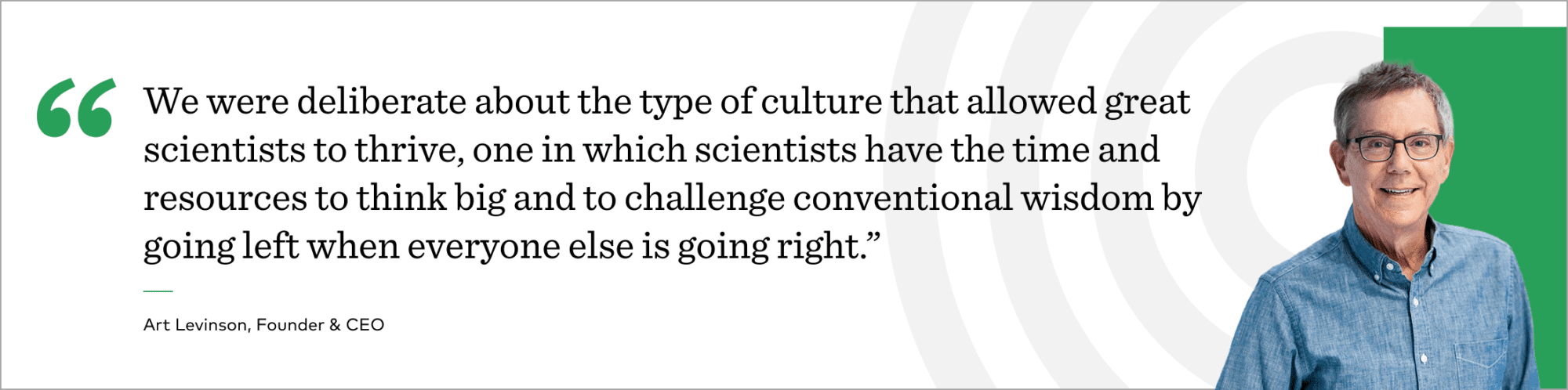
In late 2012, a dinner conversation between Arthur (Art) Levinson and the founders of Google centered on this challenge. Drawing on decades of experience, they discussed the idea of building a company designed from the outset for both long-term discovery and translation. With support from Google, Calico launched in 2013 with a dual mission: to deepen understanding of the biology of aging and to translate those insights into medicines that enable longer, healthier lives. Through the efforts of our founding team, key collaborations were established with our research partners and Calico’s own labs became operational in 2015.
Establishing a Foundation in Aging Biology Research
Early on, Calico established its research program in aging. The new team, including the renowned geneticist David Botstein and molecular biologist Cynthia Kenyon, whose discoveries with the daf-2/IGF-1 pathway first showed that aging was actively regulated, began programs in model organisms and humans to better understand fundamental questions in aging biology. To initiate translational aging studies, Cynthia initiated work on a promising aging target, the IGF1 regulator pregnancy-associated plasma protein-A (PAPP-A). Our early researchers analyzed deep human datasets to probe the roles of genetics and environment, tracked diversity-outbred mice to understand how genetics and diet interact to influence aging and lifespan, and deployed novel technologies to deeply analyze the path to replicative cell senescence. This work built a foundation that was deep, reproducible, and relevant to human health. It helped shape both our scientific direction and how we built the organization.
We established investigator-led research labs designed to pursue ambitious questions. These interdisciplinary teams work across experimental systems, from simple model organisms like yeast to human cells and tissues. Over time, this approach has generated a substantial body of peer-reviewed research and deepened understanding of pathways that influence age-related disease.
Today, our labs are conducting translational research across neuroscience, aging, stress response, oncology, immunology and other areas.
Technology and Data Enable Translation
We quickly discovered that traditional lab tools weren’t enough to capture the true complexity of biology. To move faster, we had to become inventors. We built our own Technology Labs from the ground up, bringing together experts in everything from advanced imaging and proteomics to high-throughput automation. If a technology didn’t exist to measure what we needed, we built it ourselves. Early examples included a ‘yeast lifespan machine’ to assess individual aging trajectories at massive scale and non-invasive digital profiling of aging mice.
Today, these tools are embedded across our drug discovery programs. Our biologists, chemists, engineers, and data scientists work as one team, using a mix of machine learning and AI to help interpret the complex biology we see in the lab. By combining Alphabet’s high-powered computing with massive amounts of human data–genetic, phenotypic, clinical and lifestyle–we gain insights into disease and aging that were not possible before. These insights feed directly into our machine learning algorithms for target discovery and molecular design, enabling us to precisely predict, simulate, and optimize the next generation of therapeutic candidates. This helps us bridge the gap between new discovery and a potential medicine.
Extending Impact Through Collaboration
We further extend our scientific reach and accelerate progress through shared expertise and data. Through a long-standing partnership with the UK Biobank, we study genetic and lifestyle information at population scale and connect it to measurable traits derived from our labs. Our collaboration with the Broad Institute of MIT and Harvard strengthens our ability to test hypotheses in complex biology, particularly in cancer and neurodegeneration. A cornerstone of this alliance is our work on Parkinson’s disease.
Translating Aging Biology into Clinical Medicines
Today, Calico is advancing a portfolio of clinical- and early-stage programs independently and with industry partners. This pipeline reflects our commitment to diseases in which aging-related pathways play a central role, benefiting from our foundational research.
Our eIF2B activator fosigotifator, is currently in trials for Vanishing White Matter disease as a result of our work on the Integrated Stress Response. In nephrology, our antibody targeting PAPP-A activity for Autosomal Dominant Polycystic Kidney Disease is currently in Phase 2 trials. In oncology, we are evaluating osunprotafib, a first-in-class PTPN2/N1 phosphatase inhibitor designed to bolster anti-tumor responses by simultaneously targeting immune and tumor cells
Looking ahead
Calico continues to operate with the long-term perspective that defined our founding. While advances in computation and AI are accelerating our work, our approach remains grounded in experimentation and biological validation. We continue to move forward with a dual focus: to decode the fundamental biology that controls human aging while simultaneously addressing the biological drivers of age-related disease. This is how we bridge the gap between new discoveries and availability of medicines designed to fundamentally improve human healthspan.
The Founding Vision
The Vision: Art Levinson and Google’s founders meet to define a mission focused on the profound complexity of aging.
A Unique Design: Calico is officially founded with long-term funding from Alphabet, established to combine the best of academia and biotechnology without the traditional constraints of either. Operations begin in South San Francisco with a founding team of industry and academic pioneers.
Building the Scientific Engine
The PI-Led Model: The organization takes shape around investigator-led labs, empowering interdisciplinary teams to pursue ambitious, fundamental questions in aging biology.
Inventing the Tools: Calico establishes its first Technology Labs.
Strategic Alliances: Announced major partnerships with AbbVie and the Broad Institute of MIT and Harvard to accelerate drug discovery and genetic research.
Foundational Research: Calico marks its first scientific publication in PNAS, titled “Extrachromosomal circular DNA is common in yeast”.
Licensing Innovation: Licensed Integrated Stress Response (ISR) modulators from UCSF, a foundational step for future clinical programs.
Scaling Data
Custom Technology: Built the “Yeast Lifespan Machine” and custom high-resolution 3D microscopes to observe the cellular aging cycle in ways never before possible.
Volume of Science: Surpassed 100 peer-reviewed scientific publications, validating the depth of Calico’s investigator-led research.
Clinical Transition: Submission of the first Investigational New Drug (IND) application for the ISR program (ABBV-CLS-7262/fosigotifator)
Validation and Clinical Maturity
External Recognition: Calico named one of the top biotech startups.
Population-Scale Data: Partnered with the UK Biobank to study genetic and lifestyle information from half a million participants to explore the mechanisms of chronic disease.
Scientific Breakthrough: Published discovery and preclinical results in Nature for the PTPN1/2 inhibitor, validating its potential in cancer immunotherapy.
Dosing the First Patients for VWM: Initiated clinical trials for Vanishing White Matter (VWM) disease using the eIF2B activator fosigotifator.
A Mature Pipeline
Sustained Impact: Reached a milestone of 200 peer-reviewed publications.
Clinical Recognition: Fosigotifator selected for the FDA START Pilot Program and receives FDA Breakthrough Therapy Designation to accelerate the path to a VWM disease breakthrough; PAPP-A inhibitor granted Fast Track and Orphan Drug designation to accelerate progress in Autosomal Dominant Polycystic Kidney Disease (ADPKD).